Mnemonics
Preserving knowledge through burial.

A traditional mnemonic uses the initials of listable items to jog your memory. Some people use the made-up name “Roy G. Biv” to remember all the colors in the rainbow (red, orange, yellow, green, blue, indigo, violet—not purple, it’s not “Roy G. Bip.”)
When we reckoned there were nine planets in the solar system, we used “My very easy method just shows us nine planets” (among others). The International Astronomical Union now uses “My very educated mother just served us nachos.”
Then there’s “Every good boy does fine,” which I still hear in my old music teacher’s voice. That memory triggers the memory of the first (and only) time I got detention in elementary school. I was so upset! Every good boy did not get detention!
Miss Brooks told me she couldn’t believe it and wouldn’t let the school bus leave without me that day. “I won’t let it go.” I was actually assigned to serve detention the next day, but I never told her that. So when I got on the bus at the usual time and she said, “See?”, I just nodded and smiled. She was so much in my corner, the least I could do was brighten her day. Hope she’s had a good life!
That was a big digression, wasn’t it? But it illustrates the point: mnemonics work best when we can tie them to other things. An image, a memory, a personal account. That’s why the good ones are easy to visualize.
I remember “Roy G. Biv” not because of the They Might Be Giants song included above, but because Roy G. Bivolo was the supervillain known as the Rainbow Raider. Comics: the obsession I’ve learned to use.
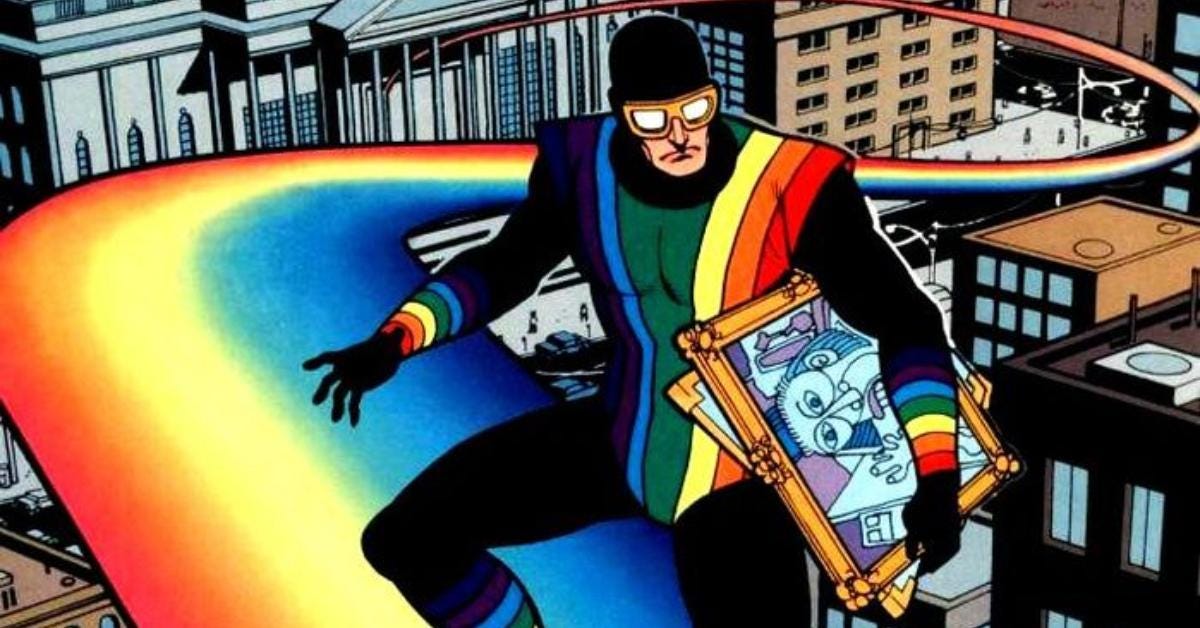
Rainbow Raider first appeared in 1980 as a deliberate throwback to the goofy villains of the 1960s. If he were introduced today, people would probably assume he was gay, or otherwise part of the LGBTQIA+ initialism. (I can’t confirm he wasn’t. What I can confirm is that he was totally color-blind—which raises lots of questions about his costume and powers, but moving on.)
I wrote a comic series once titled with an alternate form for LGBTQIA+, the acronym “QUILTBAG” (swapping out the + for a “U”). But either version brings up another point: not everyone who sees LGBTQIA+ knows everything it stands for. For instance, “A” is officially for asexual (or “ace” for short), but the term aromantic has almost as much currency. It falls under the “plus” sign, as do an increasing number of other identities, but lets focus on the first seven letters.
An “every good boy does fine”-style mnemonic won’t help enough here. “Looking good, big tall Queen Isabella! A plus!” will help you remember LGBTQIA+, but not what it stands for.
There are other cases where just remembering the initials isn’t enough. If you’re trying to recall the capital of New Jersey, then just “T, NJ” may not suffice to get you there. What to do?
As it turns out, classic Word Ways has the answer. In a 1970 article and its follow-up, Charles Karrick, Chester Karwoski, Leslie Card, and Ernst Theimer came up with mnemonics for 48 state capitals, excluding only the Dakotas. They went like so:
Schools which made law a required course do very well. (Delaware—Dover)
At the zoo, I forego nothing as interesting as a lemur. (Oregon—Salem)
She bought a new jersey when she couldn’t rent one. (New Jersey—Trenton)
Next time out, I’ll explore these “deep mnemonics” further and see if I can come up with useful ones for remembering LGBTQIA+ and other aspects of everyday life. Until then…!
When I taught Dante’s Inferno, I used the mnemonics WASPLEG to help my students remember the 7 Deadly Sins:
Wrath
Avarice
Sloth
Pride
Lust
Envy
Gluttony