The Limits of Sentiment Analysis
😜

What sentiment do you think this conveys? Positive or negative?
Ugh, just go to bed with each other already!
What about this?
Oh, you’re just bad to the bone, aren’t you?
Or this?
Bitter as a jealous ex-lover.
The answer for all three? Positive.
The first one, “Ugh, just go to bed with each other already!” is a response to a “will they or won’t they” storyline on a TV show. While the speaker is expressing surface frustration, the real message is “I’m involved with this. I have a stake in these two and their sexual tension and their potential for love.”
“Oh, you’re just bad to the bone, aren’t you?” is something to say to a cute puppy as it attacks your hand with its little paws and jaws. “Bitter as a jealous ex-lover”? That’s how some people prefer their coffee!
Phrases like these are the bane of sentiment analysis, an algorithm that tries to determine the “feeling” of text. A simple sentiment-analysis system would assign strong negative values to words like “bad,” “bitter” and “ugh,” failing the tests above.
Imagine just how easy it would be for such a system to misunderstand a four-star review of Alexander and the Terrible, Horrible, No Good, Very Bad Road Trip.
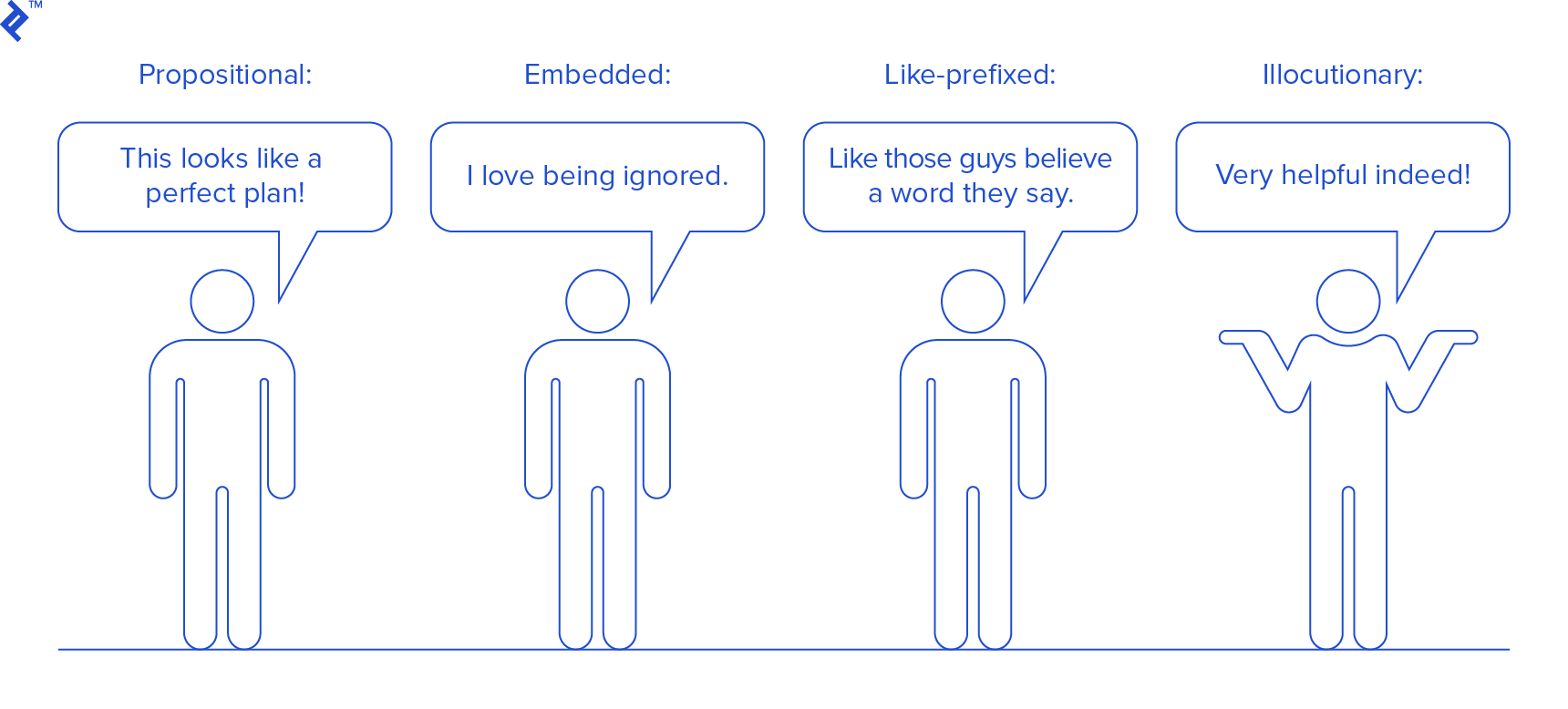
Similar problems come in when parsing sarcasm—which is difficult even for humans. Elisabeth Camp proposes four major types of sarcasm: propositional (no explicit sentiment but an implicit one), embedded (an incongruity between two sentiments), like-prefixed (using the word “like” at the beginning of a phrase to imply denial) and illocutionary (body language, gestures, and other visual elements communicating sarcasm that might otherwise be unclear).
Using an incongruous emoji could be considered a form of illocutionary sarcasm:
You killed them because you missed me? Darling, that’s…absolutely unforgivable. ❤️
This corporation has no questionable business dealings. 😜
Some sentiment analysis is much more advanced than “bad words bad.” Additional analytical tools can help it determine context,
But its complexities are still a challenge, especially when dealing with short-form feedback like internet comments. Producing comics and other entertainment online has given me a lot of experience dealing with those.
Getting back to our first example—when someone complains about how your characters are acting, does it mean they’re engaged or repelled? It depends on a few factors, including how much close reading their complaint reveals, whether they seem likely to stick around, and what behavior they’re complaining about exactly. Sometimes, when it comes to parsing others’ judgment, you have to filter it through your own.
Next: A closer look at “EMU: The Double Cross-Word Mystery”!
"Elisabeth Camp proposes four major types of sarcasm: propositional (no explicit sentiment but an implicit one), embedded (an incongruity between two sentiments), like-prefixed (using the word “like” at the beginning of a phrase to imply denial) and illocutionary (body language, gestures, and other visual elements communicating sarcasm that might otherwise be unclear)."
OH YEAH!